Biodiversity, Open space and Urban cooling, Paris
Paris, France
Description: Proposal for new open lawns in Paris
Stage: Research project
Period: Since 2018
DR team: Irène Djao-Rakitine, Amélia Chevée, Jitka Benesova

The narrow river Seine embankments attract thousands of visitors every day. Large removable planted platforms enlarge the existing embankment and create much needed green space for relaxation by the river.

Removable floating and planted platforms provide much needed green space by the river and across Paris.

The lawn typology can be applied on many different types of urban spaces. Here is an example at Bassin de la Villette where the mineral surface has been replaced by lawn creating large permeable areas and increasing biodiversity in the neighbourhood.

Our proposal for the narrow Ile aux Cygnes extends the green accessible area of the park by the river with new removable and planted platforms.

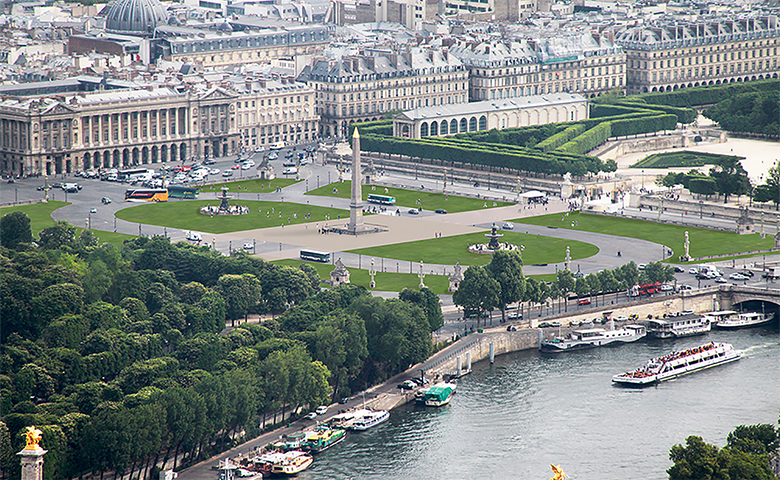
A new major green space in the centre of Paris (Place de Concorde) would favour pedestrians over cars, restore east-west continuity and reinforce the historic symmetry of the square. Read more about the Green concorde.

Planting in a mineral and densely built area such as La Défense significantly reduces urban heat, especially in hot summer months.

While Paris ring road gradually becomes a civic urban boulevard, generous open lawns over the road would provide new green space and mitigate pollution caused by heavy traffic.

Railway tracks can be covered and planted with lawns. This type of space offers recreation and sport opportunities while it connects the Square des Batignolles to the Saint Lazare train station.

One green roof on its own is anecdotic. In contrast, 1000 connected green roofs can build a strong ecological network significantly improving biodiversity and run-off mitigation across the city.

Covering unused parking roof with lawn area brings maximal effect with minimal effort. This transformation creates a new public space by the river and improves local environment.
Paris public space does not anymore fill the inhabitants' needs (in term of usage and size) nor does it respond to climate change challenges the city faces. The vast majority of accessible open spaces are sealed. Mineral or sealed surfaces have a low capacity for absorbing rainwater; they also contribute to increased air and noise pollution, biodiversity loss and urban heat.
Our project is inspired by London parks which essential elements are large open lawns framed by planted alleyways. This simple typology creates broad flexibility in terms of use (walking, relaxing, picnic, running, temporary sports fields, events, etc.).
Lawn typology also plays a vital role for environment and ecology. In comparison to hard surfaces, lawn reduces urabn heat, filters and mitigates runoff water, purifies air from dust particles. Lawn absorbs CO2, assimilates it and releases oxygen. Lawn reduces noise reverberation. A rich species mix lawn increases biodiversity. Well drained, it dries quickly after rainfall for an increased usage.
Examples we're showing here illustrate ways to spread the lawn typology across Paris.
"A City’s Surface Reflects Its Inequities", by Akiva Blander in Metropolis Mag.
All images are © Djao-Rakitine, unless otherwise stated.